Saturday, 17 April 2021

Blogging from A to Z challenge: O is for Oils

#AtoZChallenge 2021 April Blogging from A to Z Challenge letter O 

Yesterday I wrote a whole lot about Nightblooming and how I'm generally not big on DIY or kitchen witching. It also extends to using oils in general.
It's weird, because using oils seems to be such a must, or even the norm among super long hairs. But nope, I never really got into it.

I have a few oils I always keep at hand, but I'm not really good at making it a routine to use them.
I have a bottle of hemp oil at my massage therapists place instead of using her standard oil, but that's about how much routine my oil usage is.

For skin I always have: Argan and hemp oil. 

Hemp oil has a bit of a special place in my heart: Many years ago, I was outside on a hot summer day in some new slippers. I don't know how or why, but it was like the slippers caused a chemical burn or something on the bottom of my feet. I have never experienced that before or after. It hurt and burned! No matter what I did with cold water and creams, it just kept burning. I whined on LHC and someone recommended hemp oil. Hemp oil soothed the pain immediately! Since then, I've always had hemp oil at hand, but I haven't figured out a routine with it.

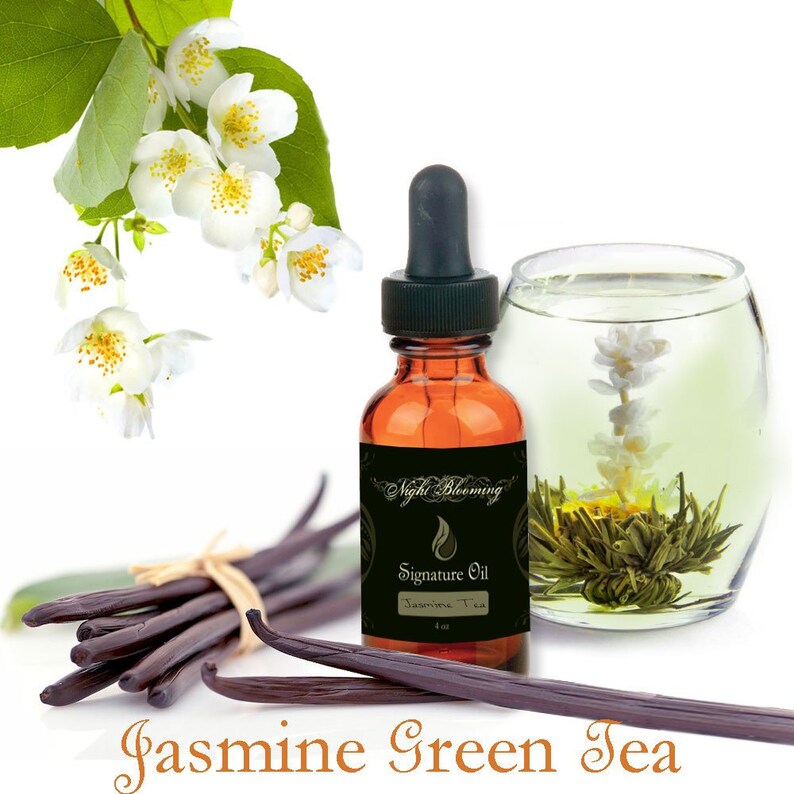
For hair: Coconut oil, argan oil and Nightbloomings Jasmine Green Tea mister.

Coconut oil has some solid science behind it as being good for hair, but unfortunately it immediately clogs up my pores, so I need to be very careful to keep it away from my skin.
Argan oil is generally good for both skin and hair.
The Jasmine Green Tea mister just smells really nice and is good for keeping my ends from drying up when I braid it or put it up.

Friday, 16 April 2021

Blogging from A to Z challenge: N is for Nightblooming

#AtoZChallenge 2021 April Blogging from A to Z Challenge letter N

It's no secret that I were never much of a kitchen witch. I think it's cool that some people can whip up all these awesome potions for skin and hair in their own kitchen, but I honestly could never really bother.
 
Since my allergies to aloe vera pressed with skin and sea buckthorn have only become worse, I'm good with leaving it to everyone else and sticking to things that are properly labelled by people in lab coats, thankyouverymuch. Basically, at this point I can't trust anything that is an "extract", since I never know if the material used to extract with is aloe vera pressed with skin, or some other nasty I react to.

The only exception I have to this rule, is Nightblooming. Who I know and trust well enough to use her products. (And who is generally an all-around cool person and wrote some classic hair literature
So whenever I post pictures of myself with cassia mud smeared all over, it's always from Nightblooming.


Writing about this made me want to do a cassia mud treatment. I haven't bothered to do those for a long while by now. 
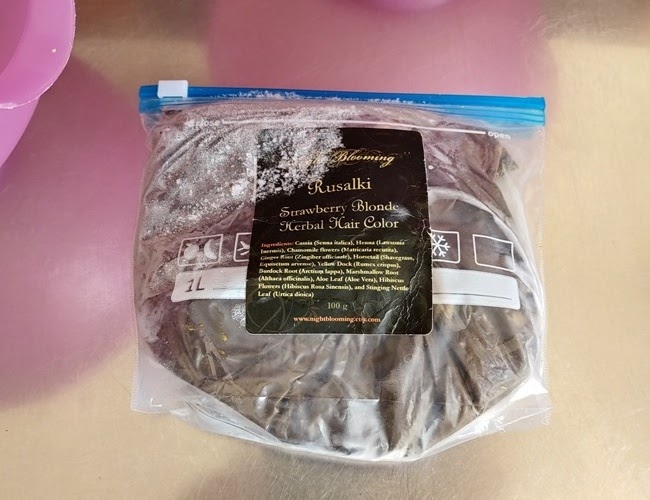
I keep a batch of boiled and frozen Rusalki Strawberry Blonde Herbal Henna Hair Color and Conditioner ready in the freezer for this. Supposedly boiling and freezing the herbs makes the plant cells break down to release the "actives" in them better.


The Rusalki is a mix and doesn't dye a whole lot, but since I want to get the can-only-spot-it-if-you-know-it effect and vague watercolour from it, I felt that three little chunks of 17 grams would be enough. 


Some people do their cassie/henna mud with just water, but I like mine as a conditioner base, so I get a good, regular conditioning at the same time. It seems to work, but of course the herbal purists always tell me I'm wrong. Meh. I'm okay with that.
I added a bottle of (ridiculously overpriced) Olaplex to it. Olaplex never really "did" anything for me, but if the science is right, it's a good product and a good choice for a long conditioning. 


100 gram of Organic Cassia Obovata to the mix. Mmm, smells like fresh peas and green vegetables.


And then I pretty much "filled up" until it had a nice, thick muddy texture. I reviewed the OGX Biotin & collagen a while back and thought it was the best choice for deep conditioner out of the four OGX I tried. So it will serve as the base for that again.


A good rinse and letting my hair semi dry again. 
Also, a before-picture. Not that I expect to be able to spot any colour difference. I actually hope I can't. 


Henna-cassia mud sexiness.
Getting it everywhere is kind of hard to avoid!


Cling wrap, bandage and... Hmm, something missing....


Doing the eyebrows too!
This mixture was surprisingly less drippy than usual. I don't know if it was the OGX Biotin & collagen or just that since cassia is a natural product, it's never 100% the same. 
I usually spend the first hour in the bathtub just because the unavoidable dripping is so much less annoying there, but I ended up cutting it a lot shorter and getting out.
I will definitely use the OGX Biotin & collagen as base again if it is what keeps the damn dripping down.


The heatcap, which mr Igor had named "The Smurf" for obvious reasons. I think I managed to kill four hours like this before I got bored.


Rinsed clean and can't see any colour difference. Good!


Still moist, braided and still can't see any colour difference. Maybe a little in the eyebrows, strange enough?


Fully dried and up in a braided Nautilus bun. Maybe it's the contrasting, green hoodie, but now I actually think I can see a little bit of a tint. Not at the length, but at the scalp it seems a tiny bit more red than normal. But this is the can-only-spot-it-if-you-know-it tint I wanted, so I'm happy. 
And my hair felt generally happy. It looks shiny and nice. 


Melissa/Nightblooming is found the following places: 

And speaking of Nightblooming, her Etsy store is turning 14 years old this week!
She usually has a sale going on around her store's birthday, so it's worth checking out.

Thursday, 15 April 2021

Blogging from A to Z challenge: M is for Music

#AtoZChallenge 2021 April Blogging from A to Z Challenge letter M

On a whim, I decided to go for "music" for M for a fun little break from all the text. But once I started looking, I found a lot. Like, fascinatingly much.


Andrew Bird - Music Of Hair


AOA - Short hair


The Beatles - Lend me your comb


Bright Eyes - Pull My Hair


D.A.D. - I Won't Cut My Hair


India.Arie - I Am Not My Hair ft. Akon


The Cowsills- Hair


Hair - The Hair song


Julie Brown - Cause I'm a Blond


Kelly Rowland - Crown


Lady Gaga - Hair


Led Zeppelin - Long Brown Wavy Hair


Niki and Gabi - Hair tie


Nina Simone - Black Is The Color Of My True Love's Hair


Little Mix - Hair ft. Sean Paul


MAGIC! - Let Your Hair Down


Pavement - Cut Your Hair


R. Kelly - Hair Braider


Sesame Street - I Love My Hair


Solange - Don't Touch My Hair ft. Sampha


The Vamps - Hair Too Long


UFO YEPHA- Op med håret
("Put your hair up", literally "Up with the hair")


Willow Smith - Whip My Hair

Okay, the last one is about beards but still...


Natalie Portman's Shaved Head - Beard lust

Wednesday, 14 April 2021

Blogging from A to Z challenge: L is for Leave in conditioners

#AtoZChallenge 2021 April Blogging from A to Z Challenge letter L 

Back on the 3rd I mentioned the three most important tips for growing hair long, that I encountered with I first found the longhair circuit.

Blogging, Conditioner-based washing methods, and number three is using leave in conditioners. 

Leave in conditoners are awesome!
They make hair so much easier to manage by both adding slip and grip depending on the product. They add some hold and control to your updos. They add shine and a nice scent. They protect your hair from wear and weather. Some even have UV protection!
(And if they don't, you can usually get away with adding a tablespoon of regular SPF to a 200 ml bottle without messing too much with the product)

Depending on your hair type and what you want from them, there is something for everyone.

In short: They are awesome and everyone should use them.

Tuesday, 13 April 2021

Blogging from A to Z challenge: K is for Ketylo

#AtoZChallenge 2021 April Blogging from A to Z Challenge letter K

The Ketylo hair stick is something I don't think gets enough credit in the longhair circuit.
Although there are other hair tool makers out there who have tried to copy the idea, Ketylos have the best shape from what I've seen.

Why do I find Ketylos so brilliant?

Simple. The vague corkscrew shape. Not too much, not too little.


For someone with as much hair as me, it helps me with two important things:

1) Inserting the hair stick. Instead of pushing into a single, stuck track, you can screw the hair stick in. It helps the stick to find the path of least resistance through your hair instead of being forced in a pre-set path. You can never get the strain on your hair 100% uniform, so you want to avoid the high tension spots that can hurt you.

2) It helps ease the load of holding up the updo. If your updo doesn't feel completely comfortable, simply rotating the Ketylos can pinpoint a position where your stick is more comfortable than another. For someone who absolutely hates messing with her hair once it has been put up, this is an important point.

Saturday, 10 April 2021

Blogging from A to Z challenge: I is for Ingredients to look out for

#AtoZChallenge 2021 April Blogging from A to Z Challenge letter I

This is my personal list of ingredients I look out for in a product. Unfortunately this is not a complete list, since that would be several pages long, but this is just a rough overview. 

As a general rule, I like silicones. It probably comes with the coarsie-territory, but I never had issues with cones and they really help to keep my hair manageable. 
Amodimethicone is a cone particularly prone to build up.
Dimethicone is an emollient and silicone
Dimethiconol is a silicone polymer, which is a non-water soluble film former. Since it isn't water soluble, it's a silicone that builds up easily. 

I also like Quaterniums. I know some don't. 
Polyquaternium-10 is a quaternium ammonium compound that is particularly prone to building up.
Polyquaternium-37 is a quaternium ammonium compound and will bind to the damaged areas of hair.
Quaternium-87 is a quaternium ammonium compound and will bind to the damaged areas of hair.

I generally try to avoid too much proteins since my hair is as coarse as it is. Protein just attaches to the surface and can't penetrate to where it should go, so it leaves my hair crunchy and irritated.
Arginine is an amino acid found in human hair and supposedly promotes circulation and stimulates growth hormones to prevent hair loss.
Betaine is an amino acid with humectant properties.
Cocodimonium Hydroxypropyl Hydrolyzed Keratin is a protein
Hydrolyzed Keratin is a protein
Hydrolyzed collagen is a protein
Hydrolyzed keratin is a protein
Hydrolyzed Soy Protein is a protein

I also have a list of more or less random ingredients I like in my products.
Allantoin has a soothing effect on skin.
Cetearyl Alcohol is an emulsifier which means it lowers the surface tension between oil and water so it can dissolve oils and be used for cleansing
Cetyl Alcohol is an emulsifier which means it lowers the surface tension between oil and water so it can dissolve oils and be used for cleansing
Cetyl Esters is an emollient that soften hair and soothes the scalp
Creatine rebuilds and strengthen the hair structure  
Glycerin is a really good moisturizer and an humectant.
Niacinamide aka vitamin B3 is a very effective skin-restoring ingredient against ageing and environmental stress. Not entirely sure what good it would be for hair, but I can't protest against having it in a product that touches my scalp.
Panthenol does maybe-maybe not penetrate and strengthen hair.

I love sunscreen in my products! I'm not sure how much good it does, especially in rinse-off products, but I don't care. Even the tiniest little bit of effect is better than none.
Avobenzone is the best UVA protection of non-mineral filters, but also protects against UVB. Good safety rating.
Ethylhexyl Triazone is a sunscreen protecting against UVB radiation.
Homosalate is a UVA and UVB protector with a decent safety rating.
Mexoryl SX has strong UVA protection
Octinoxate (Octyl methoxycinnamate) is a powerful UVB protector with a bad safety rating. It also goes under the name of Ethylhexyl Methoxycinnamate and octyl methoxycinnamate. I dig into this one a little bit more here
Octisalate is a UVA and UVB protector with a decent safety rating.
Octocrylene is a UVA and UVB protector with a decent safety rating.
Oxybenzone is a UVA and UVB protector with a bad safety rating. It could be a problem for sensitive skin types and there are some concerns about its impact on the oceans.
Titanium dioxide is a physical UVA and UVB protector with a decent safety rating.
Zinc oxide has excellent, physical UVA protection, but also protects against UVB. Is a potential acne trigger even though it’s generally considered safe for skin.

I generally avoid extracts, because you never really know what actually is in them. There is an episode of The Snailcast where Shell of Holysnails talks about how a supplier to her webshop offered her ruby extract to add to her products. Which is completely nonsensical, but explains a lot of what extracts can be. It can be something good, but it can also be a root quickly dipped in a bucket of alcohol. What it takes to extract the extract is never specified.

Friday, 9 April 2021

Blogging from A to Z challenge: Habits

#AtoZChallenge 2021 April Blogging from A to Z Challenge letter H 

H is for for habits.
Perhaps the most well known and classic hair advice is to practice benign neglect. And I agree: It's important.
But, I think the advice should probably be more like "Practice good habits" instead.
Benign neglect points to more of a "Do as little as possible"-approach, which is very close, but not entirely the same as building some good, hair friendly habits.
After all, I think for most people "Do as little as possible" can leave you... Well, gross and with boring hair. And why grow your hair long to begin with, if you don't use it for fun and interesting updos?

But habits are important. 
It's a matter of being effective in your care and handling.
Spending just a few minutes extra every day doing something destructive to your hair, or doing something good for your hair, it doesn't seem like much for the day, but after years or even decades... It really adds up.

I try to always do my detangling and updos in front of the mirror. If I start getting annoyed at my hair tangling, my temper wins and my hair loses. So being able to see my face and reactions is often enough to stop me from ripping through the offending tangle.
I keep a scissor near my favourite monitor because the contrast is so good for finding and snipping damage.
I keep a small spray bottle of SPF in all my bags, in case I spend more time outdoors than planned so I can protect my hair and skin. I'm a little obsessed with sun protection for my hair, since it can't repair itself. 
I often use my braids several days in a row. It saves me so much time and it saves my hair a lot of handling.
My weirdest habit is probably that I remove the tags in my shirts. Since I have to pull at least one shirt over my head four times a day, it really adds up. Those little tags can be quite rough. 

Thursday, 8 April 2021

Blogging from A to Z challenge: G is for genetics

#AtoZChallenge 2021 April Blogging from A to Z Challenge letter G 

I think when it comes to hair, one of the things that fascinates me the most is the genetics.
Both from the point of view that all you can really, truly do is to maximize the potential genetical maximum through proper care and handling. You can't out-nutrition or out-care your genetic blueprint.

...But also because it seems like so much of the textbook knowledge out there just seems so plain wrong.

Is it just me?

How often do you hear/read that the active growth phase (The anagen phase) is genetically predetermined and is only 2-6 years? 
How often does that seem to be true?

I always wants to say "Well, yes, maybe for balding men, I guess" but I have seen enough balding men with ponytails to say that isn't true. Two years of hair growth is around shoulder length for most people, three years around armpit length. I'd say two years is wrong, but three might be an option if we speak of all people in general, since many with fine, fragile or very curly hair have trouble reaching more length. But two? Nah. Not buying it.

And then there is the maximum active growth phase, so often quoted to 6 years. That should be around tailbone or classic or so depending on your height. Of course when you grow your hair for so many years, you are pretty much guaranteed to trim a lot of the ends off. Actually, I would say it's pretty damn hard to grow nice-looking hair of that length if you don't trim on the regular! 

Anyways. Maybe it's just me, but the numbers quoted of years for hair growth in the anagen phase always seemed off to me.


Back in 2019, Mr Igor and I did the 23andme tests, which is a story in itself. Here and the follow-up here.
It was really interesting from a hair genetics point of view too, because I didn't know there was so much depending on your genes when it came to hair. Now it almost feels like a "Well, duh?" kind of thing, but I guess I never really thought of it before. 
Before that, I just knew of the basics: pheomelanin gives you red hair tones, and the amount of eumelanin regulates how dark your hair is. 


I didn't know that photobleaching was a genetic factor. I always thought it was sort of a by-product of having lighter hair, especially when it seems to be so common among native Scandinavians. Everyone I know with lighter hair gets it lightened in the summer. I mean, most things, such as fabric and wood goes paler when exposed to sunlight too?
The loss of colour comes from a loss of protein and structure in the hair, so the paler colour is a sure sign of damage to the length. I'm only slightly obsessed with SPF in my haircare products. After all, skin can to some degree repair itself after sun damage. Hair can't. 
But supposedly a massive 48 genes plays a role in whether your hair loses colour from sunlight or not. 


How much or little curl you have in your hair is said to depend on the shape of your hair follicle, and this also involved way more genetics than I expected. 


Maybe it's just me, but I find the sheer numbers of genes involves in something so simple to be  fascinating. I remember us using hair colour (As well as eye colour) as simple examples for Mendel's second law in primary school biology, and now as an adult I look at this genetic mess that determines my hair colour and learn that it isn't that simple!
I would really like to know more about how this works though. It seems for most people, their hair pick a narrow range of colours to grow, but for me, I can find individual hairs ranging from light blond to dark brown. 

(And no, I know mr Igor isn't cheating and I'm finding someone else's hairs all over our place. I would be very impressed if he managed to find a side piece who also grows 1½ meter long hair. As far as I know, that's not mr Igor's thing) 


Another hair related trait I was surprised to see pop up was dandruff. I have a tendency to get some very light dandruff in the late autumn/early winter, but I always wrote it off as being due to the weather changing: When it gets cold and wet outside and hot and dry inside, it always triggers some light scalp irritation. But since 23andme doesn't predict that I have dandruff, it might be more of a sensitive skin issue? That I do have.
 

I was genuinely upset that they only gave me a 6 % chance of having red hair. I always felt I had some red tones in my hair and really appreciated them. But meh.
I don't care what they say though. I think red hair is amazing. Maybe it's the rarety of red hair I like. Both for the mostly-Celtic genetic variant and the Melanesian genetic variant. I just think the colour is really pretty! 


The red colour comes from pheomelanin, but you also need to have lower levels of eumelanin for the pheomelanin to really show through the dark colour.


It's funny: The widows peak is another one of those traits I remember from biology class. Along with little tidbits like that how you fold your hands is genetically predetermined (And folding them opposite feels really crazy wrong) and folding left thumb over is the dominant gene. But maybe that's wrong too. I mean, it's been over two decades since I sat in a biology class, so I actually kind of hope my knowledge is outdated?

I also remember that male pattern baldness was tied to the X-chromosome, so since men only have one, it explains why men usually either go bald fast or not at all. They simply don't have a "backup" to soften the effect, like women do. The knowledge seems to still hold true today. But since 23andme didn't bring it up for Mr Igor, I guess that it isn't that simple? Or maybe they don't want to get sued.


The widows peak also have a bunch of genes involved. More than you would think. Okay, less than for some of the other traits, but still. 


Now, one hair related trait I was slightly disappointed in not seeing any info on was hair growth. It would have been fun to see what my maximum genetic capacity is, but maybe such info does exist? 
After all, everyone always assume my hair grows a lot faster than it does, but I only get 1,5 cm each month and 2-3 months in the middle of the summer with 2 cm. 
It's a nice and very average growth rate, but really not impressive in any way. 
It would have been fun to know if I'm even close to maximizing my potential growth rate, or, dunno, I need to eat more proteins? 

Wednesday, 7 April 2021

Blogging from A to Z challenge: F is for Fia’s hair typing method

#AtoZChallenge 2021 April Blogging from A to Z Challenge letter F 

In internet terms, Fia's hairtyping system is absolutely ancient and have had an internet presence back in 2003 or even before. It is so well known it has even made it's way into Wikipedia's definition!

Why is hair typing useful?

Your hair type can tell you a lot about what should work for you, and what shouldn't. 
It is a tool to help you find similar heads of hair and to take a look at what is working for others with comparable hair types. It also makes it a lot easier to answer questions on the forum and recommend a good routine for your hair type.

How do I find out my hair type?

Wash your hair as you usually do. You do not need to use other products, clarify or change your regular routine. The hair type which really matters is the one you are dealing with day to day and not so much the one you could have if you just clarified. Of course your true natural hair type will come out most when your hair is absolutely clean from all product leftovers and it's also neat to know how much different routines alter ones hair type, but clarifying is not a necessary requirement to type your hair.

Let your hair air dry with the least amount of detangling you can manage to do. Detangling before washing and while your hair is still wet is totally fine, just avoid doing it (as much as reasonably possible) during the time it is air drying. Finger combing, combing and brushing during that time will change the structure of your hair you are just trying to discover. Not all hair types can manage to dry totally untouched, still it's best to keep it to a minimum to avoid changing the results.

Examine your dry hair.

First classifier - Your curliness (or lack thereof)
The straight ones
1a - stick straight
1b - straight but with a slight body wave, just enough to add some volume, doesn't look wavy
1c - straight with body wave and one or two visible S-waves (e.g. nape of neck or temples)

The wavy ones
2a - loose, stretched out S-waves throughout the hair
2b - shorter, more distinct S-waves (similar to waves from braiding damp hair)
2c - distinct S-waves and the odd spiral curl forming here and there

The curly ones
3a - big, loose spiral curls
3b - bouncy ringlets
3c - tight corkscrews

The very curly ones
4a - tightly coiled S-curls
4b - tightly coiled hair bending in sharp angles (Z-pattern)

Second classifier - Individual strand thickness
Many people have a mixture of fine, medium and coarse hair, just pick the classifier which applies to most of the strands.

F - Fine: Thin strands that sometimes are almost translucent when held up to the light. Shed strands can be hard to see even against a contrasting background. When rolling a strand between your thumb and index finger, fine hair is difficult to feel or it feels like an ultra-fine strand of silk

M - Medium: Strands are neither fine nor coarse. When rolling a strand between your thumb and index finger, medium hair feels like a cotton thread. You can feel it, but it isn't stiff or rough.

C - Coarse: Thick strands that where shed strands usually are easily identified against most backgrounds. When rolling a strand between your thumb and index finger, coarse hair feels hard and wiry. As you roll it back and forth, you may actually hear it.

Third Classifier - Your overall volume of hair
Put your hair in a ponytail with as much hair as possible in it. Don't bother with the way it looks - the goal is to have most/all of your hair in there. If it means it sits smack dab on top of your head to include face framing layers or bangs, put it there.

Measure the circumference of the ponytail. If you have short bangs and/or you can't get all of your hair in there adjust according to how much of your hair you have measured.

i - thin (less than 2 inches/5 centimeters)
ii - average (between 2-4 inches or 5-10 centimeters)
iii - thick (more than 4 inches/10 centimeters)

Notes
When to use the in-between classifiers - examples of indecisive hair syndrome
There are lots of different reasons why you can choose an in-between classifier. It is not an exclusive list and just meant to give you an idea for when to pick an in-between classifier.

If your hair shows more structure in one typing picture than in another one.
If you simply can't decide if it's 2c or 3a.
If you can't see a majority for one structure, like 50% 2c and 50% 3a.
If your hair is only containing about equal amounts of medium and very coarse strands, but next to no fine strands M/C.
If you are getting inconsistent measurements for the over all volume of your hair every time you try. 3.5 inches one time, the next time slightly above 4 inches. Or if it's right at 4 inch.

Scalp typing
Personally, I would also like to see a scalp-typing method as well.

Since the different absorption of sebum results in both oily and flakey residue on the scalp, I would think a system like OxFx.

The method to find out your scalp type should be as follows: Wash your hair like normal. Then count the days before your hair is noticeably A) Oily and B) Flakey with no washing. 
So the number would be between 0 and 9 days for both.
And absolutely no number over 9, because gross. No excuse to not clean your hair for longer, especially not for showing off for internet clout. Seriously. Ick.

So a scalp type would be something like O4F2 or something like that.

For a lot of people, the scalps needs are as important, if not more, than the length of your hair.
Having a mostly flakey scalp makes you have to treat it differently than a mostly oily scalp.